Digital Clocks for Synchronization and Communications
This text explains important phase-lock circuit design techniques, and how to select commercially available equipment for a variety of projects in the field.
 TABLE OF CONTENTS
 Simulation is an effective tool for analyzing the characteristics of digital PLL constructions, since it is often difficult to find any closed-form arithmetic relationships in their behavior. In addition, because of increased computer power, simulation is an attractive and precise alternative if we are interested in a characteristic whose measurement is difficult or would take a lot of time. This chapter describes the validity of PLL simulation.
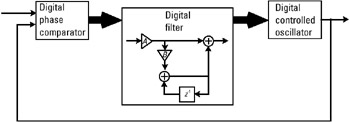
Let us consider a basic digital PLL that is composed of a digital filter (described in Section 5.4.2), a digital phase comparator, and a digital controlled oscillator, as shown in Figure 6.1. A complete transfer function is hard to obtain, but a reasonable analysis is possible through an equivalent analog PLL in the region where the quantization effect can be ignored.
Let us compare the transfer function of an analog PLL calculated according to (5.36) with the measured data of the digital PLL, which uses the following coefficients:
Phase comparator:
Phase difference detection resolution: 6 ns;
Sampling: 8 kHz and 0th hold;
Filter:
Type: complete second-order filter as expressed in (5.42);
Proportional coefficient of multiplication: A = 32;
Integration coefficient: B = 6 10 ?5;
Sampling period in integration: 8s;
Controlled oscillator:
Resolution of digital frequency control: 1 10 ?12.
Figure 6.2(a) shows the transfer function for a variation in the input phase of the PLL. This is the characteristic of a general lowpass filter. Figure...