Digital Clocks for Synchronization and Communications
This text explains important phase-lock circuit design techniques, and how to select commercially available equipment for a variety of projects in the field.
 TABLE OF CONTENTS
 Complicated units are not normally used in the analysis of PLL characteristics. The most common units are frequency [Hz], phase [rad], phase-time [s], and voltage [V]. However, which of these units are used is very important. The equations described in Chapter 5 are reconsidered in terms of these units.
Let us consider the units of the coefficients used in the basic equation that is based on the phase difference between the input and output signals as per (5.6) of Section 5.1.3.
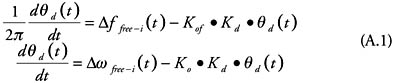
The units on both sides of (A.1) are angular frequency [rad/s]. The units of the second term in the right must be [rad/s] as well. ? d( t), which is included in the second term on the right, is the phase difference between the input and output signals as shown in (A.2), and its units are [rad/s].

This phase difference information is converted into voltage in the phase comparator. K d is the total sensitivity of the phase comparator and represents its output voltage. The unit of sensitivity is [V/rad]. K o is the sensitivity of the controlled oscillator. Since the output angular frequency is determined by the voltage of the phase comparator output, its unit of sensitivity is  Therefore, the second term on the right of (A.1) has units as given by

This unit system can be used in the analysis of multiplier-type phase comparators as well (which are not described in detail in this book) if...