Digital Clocks for Synchronization and Communications

This text explains important phase-lock circuit design techniques, and how to select commercially available equipment for a variety of projects in the field.
 TABLE OF CONTENTS
 A signal provides information about the state of a system. The initial form or nature of a signal can be acoustic, thermal, ionizing radiation, or electronic. Familiar examples include circuit voltages and electric currents. Different system requirements may demand signal processing, which alters or extracts some or all of the characteristics of the signal. Analog signals can be described by their amplitude, frequency, phase, and spectral content. There is a wide variety of processing actions: unnecessary signals can be removed, just one specific signal component can be extracted, and one component can be converted into another form.
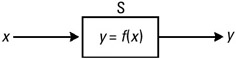
The most fundamental description of signal processing is that one obtains the output signal y with the required characteristics from the input signal x using a defined system S (see Figure 3.1). The result is shown in abstract form as a symbol f(*). In many cases, because f(*) is often a function of time t, Figure 3.1 can be rewritten using input signal x and output signal y as shown in Figure 3.2. The variables, however, cannot be assumed to be always bound to time. They often have the meaning of position, and a variable can have two or more simultaneous meanings as well.
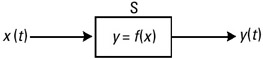
In this chapter, system S in Figure 3.2 is assumed to be linear and...