Electrical Equipment Handbook: Troubleshooting and Maintenance

Chapter 6: Induction Motors

In induction machines, the rotor voltage (which produces the rotor current and the rotor magnetic field) is not physically connected by wires to the rotor windings it is induced in the rotor. The main advantage of induction motors is that there is no need for dc field current to run the machine. An induction machine can be used as a motor or a generator. However, it has many disadvantages as a generator.

INDUCTION MOTOR CONSTRUCTION

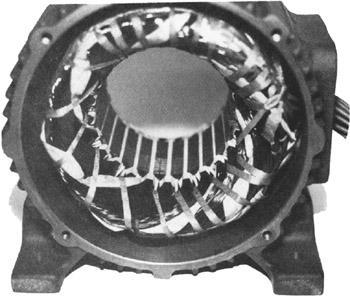
Figure 6.1 illustrates a typical two-pole stator for an induction motor. The two main types of rotors are squirrel-cage and wound rotors. Figures 6.2 and 6.3 illustrate squirrel-cage induction motor rotors.


Figure 6.1: The stator of a typical induction motor, showing the stator windings. ( Courtesy of MagneTek, Inc.)

Figure 6.2: ( a) Sketch of squirrel-cage rotor. ( b) A typical squirrel-cage rotor. ( Courtesy of General Electric Company.)

Figure 6.3: ( a) Cutaway diagram of a typical small squirrel-cage induction motor. ( Courtesy of MagneTek, Inc.) ( b) Cutaway diagram of a typical large squirrel-cage induction motor. ( Courtesy of General Electric Company.)

The rotor consists of a series of conducting bars installed into slots carved in the face in the rotor. These bars are shorted at both ends by shorting rings. This design is known as a squirrel-cage rotor. The second type is known as a wound rotor. A wound rotor (Figs. 6.4 and 6.5) has three phase windings that are...

UNLIMITED FREE
ACCESS
TO THE WORLD'S BEST IDEAS

SUBMIT
Already a GlobalSpec user? Log in.

This is embarrasing...

An error occurred while processing the form. Please try again in a few minutes.

Customize Your GlobalSpec Experience

Category: Brushless Motors
Finish!
Privacy Policy

This is embarrasing...

An error occurred while processing the form. Please try again in a few minutes.