Electrical Equipment Handbook: Troubleshooting and Maintenance

| 1. | What is the normal operating speed of an induction motor? |
|
| 2. | How will the torque, current, and slip vary in a motor driving a pump when the flow through the pump increases? |
|
| 3. | How will the current vary in a motor driving a pump when the flow through the pump increases? |
|
| 4. | How will a decrease in power supply voltage affect the capability of the motor? |
|
| 5. | What class of motors should be selected for driving a centrifugal pump? |
|
| 6. | What class of motors should be selected for driving an electric actuator or a heavy flywheel? |
|
| 7. | Can a class D motor be used to drive a centrifugal pump? |
|
| 8. | What is the difference between an induction motor and a synchronous motor? |
|
| 9. | What is the nature of the inrush current pulled by a motor? |
|
| 10. | What is the service factor of a motor? |
|
Answers
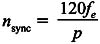
| 1. | The synchronous speed of an induction motor is given by where n sync is the synchronous speed of the motor. This is the rotational speed of the magnetic flux inside the stator of the motor (around the rotor). And p is the number of poles. It could be 2, 4, 6, 8, etc. Also f e is the frequency in the power supply. In North America, it is 60 Hz. In western Europe, Australia, and New Zealand, it is 50 Hz. Based on this equation, the synchronous speed for a motor supplied with 60 Hz power... |