Electrical Equipment Handbook: Troubleshooting and Maintenance

Vibration is defined as small oscillations about some equilibrium point. The main characteristics of vibration are amplitude and frequency.
Figure 23.1 illustrates the movement of a piston driven by a crankshaft moving up and down in a cylinder. The position of the centerline of the piston above the centerline of the cylinder (equilibrium position) is assumed positive. When the piston is at top dead center, the piston centerline will be at the maximum positive distance above the cylinder centerline.
The plot of the piston versus time is given by a sine curve. The period of the sine wave is 1 s (the frequency is 1 Hz). The maximum peak (or amplitude) of the motion is D.
The energy produced by the motion is related to the area under the curve (Fig. 23.1c). The rms value of the amplitude is equal to 0.707 times the peak value of the amplitude. It represents the steady value of the amplitude that gives the same energy as the sine curve.
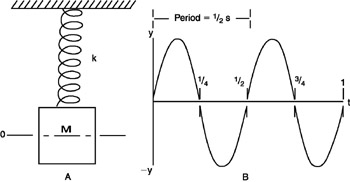
Any vibration can be described by a sine wave. The crankshaft/piston arrangement shown in Fig. 23.1 can be described by the spring mass system shown in Fig. 23.2.
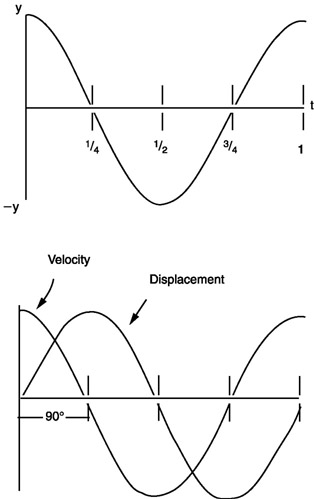
Figure 23.3 illustrates the variation of velocity with time. The velocity curve is actually a cosine wave. It leads the displacement curve by 90 .