Electrical Equipment Handbook: Troubleshooting and Maintenance

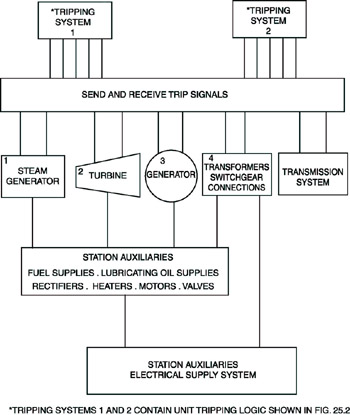
Figure 25.1 illustrates the overall protection scheme in a generating station. The auxiliary equipment inside the plant requires 5 to 10 percent of the power generated. The remainder goes to the grid. Since the plant is closely interconnected, a single failure requires more than the electrical and mechanical disconnection of the faulted system. This chapter covers the following topics:
The main unit protection. It includes the electrical protection of the plant equipment for which faults result in the tripping of one of the main plant systems.
The methods used to initiate the tripping of other associated plant systems.
The protective systems are designed to disconnect the faulty system when faults occur. The following are the main design requirements for the protective systems in power stations:
A system must be disconnected as quickly as possible when a fault occurs on it.
A secondary or a backup protection must be able to clear the fault if the main system protection did not clear it.
The system protection must be designed to match as closely as possible its operating characteristics; e.g., the generator negative sequence protection must be designed to match its thermal withstand to negative phase sequence currents.
The protection systems should generally be designed to prevent failure of a single protective device from causing a trip or allowing a fault to remain connected to the system. The exception occurs where the probability of failure of the protective device is very low such...