Electrical Equipment Handbook: Troubleshooting and Maintenance

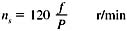
A synchronous machine operates at a fixed speed determined by the frequency of the power supply connected to it. The normal operating speed of the machine is known as the synchronous speed, given by
where f = frequency of applied signal, Hz, and P = number of poles of the synchronous machine. In a synchronous machine, the relationship between the operating speed and the frequency of the power supply connected to it remains unchanged.
Synchronous machines have a wide range of output power applications. On the low end, the clock and timing motors and control alternators are in the milliwatt range. At the high end, the large alternators used in electric power generation have exceeded 1500-MW output power.
Synchronous machines are called alternators when used as generators. The smallest alternator is probably an ac tachometer. It is used as a speed sensor.
Synchronous motors have a wide range of applications. They are used in clocks and recording devices. The power rating of these motors varies from a few hundred watts to more than 100 MW. They operate at constant speed in a variety of applications including compressors, pumps, and drives for textile mills.
A synchronous machine has two electrical windings. They both provide excitation for the machine. The armature winding is where the main voltage is induced. The effect (excitation) that the current flowing in the armature winding has on the voltage developed in it is called the armature reaction. The field...