Failure Analysis of Engineering Materials
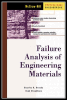
This text introduces the important aspects associated with the failure analysis of engineering components, and provides a treatment of both macroscopic and microscopic observations of fracture surfaces.
 TABLE OF CONTENTS
 As is usual in a severe frost, we have recently heard of many severe accidents consequent upon the fracture of the tires of the wheel of railway-carriages.
JAMES PRESCOTT JOULE
Philosophical Magazine , 1871
The overall macroscopic orientation of the fracture surface of a broken component is generally related to the loading conditions. The relationship between this orientation and the load may be complex and difficult to deduce, but in spite of this, in many cases considerable information may be gleaned from the fracture-surface orientation. For example, if the fracture clearly did not involve any plastic deformation (as deduced from the absence of significant geometric or dimensional change) and hence the fracture was brittle, and the macroscopic fracture surface was relatively flat, then fracture probably occurred by a stress normal to the fracture plane.
The purpose of this chapter is to review mechanics aspects which are related to the cause of the fracture-plane orientation. The principles are outlined only in sufficient detail to illustrate their application, and examples of macroscopic fracture surfaces are given to demonstrate the ideas. It is emphasized that it is the macroscopic fracture-surface orientation that is the subject of this chapter. The detailed fracture-surface topography is the subject of Chaps. 3 and 4.
To introduce the concepts of loading and fracture, it is useful to examine the simple tensile test. This provides a definition of the common tensile mechanical properties and also allows distinguishing between elastic and plastic...