Failure Analysis of Engineering Materials

This text introduces the important aspects associated with the failure analysis of engineering components, and provides a treatment of both macroscopic and microscopic observations of fracture surfaces.
 TABLE OF CONTENTS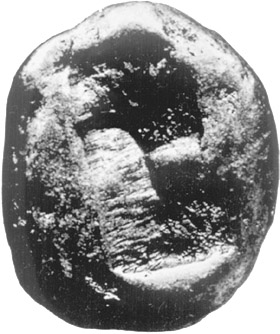
Persian SIGLOS, fifth century b.c., showing impression of fractured bronze (?) punch (4 ).
C. S. SMITH
A History of Metallography,
University of Chicago Press, 1960
When the fracture surface of a broken component is examined with the unaided eye or at low magnification (such as <20 ), distinct topographical features are usually seen. Deduction of the mode of fracture based on this macroscopic examination relies on the correlation of characteristic features with known fracture conditions. Fortunately there exists a wealth of experimental observations of the fracture surfaces of test samples fractured under known loading conditions, and in most cases the topographical features are quite unique for each type of loading condition. The orientation of the fracture surface of a broken component often reveals unambiguously the loading condition which led to fracture, and this was examined in Chap. 2. The microscopic process whereby metallic materials fracture was called mechanism (or micromechanism), and the associated fracture-surface fine-scale topography was the subject of Chap. 3.
In Chap. 4 the types of fracture mode and the associated macroscopic fracture-surface topographical features are examined. The term fracture mode is used to indicate the type of external loading that causes fracture; this could be called fracture macromechanism. The simplest modes are described first (such as simple tensile loading), then more complex cases are examined. We conclude the chapter by illustrating the microfractography of test samples of known fracture modes which have specific macrofractographic appearances.
In the tensile...