Failure Analysis of Engineering Materials

This text introduces the important aspects associated with the failure analysis of engineering components, and provides a treatment of both macroscopic and microscopic observations of fracture surfaces.
 TABLE OF CONTENTS
 It is customary to indicate the magnification on a photograph of a microstructure (micrograph), but when the photograph size is changed (such as enlarged), the original magnification must be corrected. A method of avoiding this is to place on the micrograph a bar or marker that has the correct dimension for the magnification of the photograph. Then if the magnification of the photograph is changed, the marker also changes dimensions to maintain the correct dimension at the new magnification.
For example, consider a micrograph at 100 . Then a marker 1 cm long would correspond to a dimension of 1/100 = 0.01 cm. It is common to express this in micrometers. Since a micrometer is equal to 10 -4 cm, then the 0.01-cm dimension could also be labeled as 100 mm (0.01 10,000). If the micrograph is enlarged 2.5 times, then the marker becomes 2.5 1 = 2.5 cm long, and it is still labeled as 100 mm.
In general,
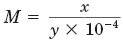
where M is the magnification, x is the marker length in centimeters, and y is the marker value in micrometers on the micrograph.
At very high magnification, the marker value may be less than 1. For example, if the magnification is 40,000 , then 1 cm would correspond to 0.25 mm. In such cases, the marker corresponding to a certain value in angstroms ( ) may be used. 1 is equal to 10 28 cm, so in this case the marker...