Failure Analysis of Engineering Materials
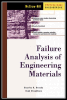
This text introduces the important aspects associated with the failure analysis of engineering components, and provides a treatment of both macroscopic and microscopic observations of fracture surfaces.
 TABLE OF CONTENTS
 "Fractography" is the name we have applied to this technique. Reticence in introducing a new term is counteracted by the advantage in substituting a word for a phrase as long as "the micrographic study of cleavage facets on fractured metal specimens," which is the definition of fractography. In addition, the word fractography has some etymological correctness in stemming from roots similar to those affording metallography, for "fracto-" is the combining form of the Latin "fractus," meaning fracture.
C. A. ZAPFFE AND M. CLOGG, JR.
Transactions of the American
Society for Metals, 1945
In this chapter we review the common processes which occur on a relatively fine scale when a material is subjected to increasing loads, and which lead to material separation (fracture). Since at this scale the human eye cannot resolve individual features, the use of microscopes is required. These processes can be referred to as fracture micromechanisms, but we will use the term fracture mechanisms. This distinguishes the fine-scale processes from the coarser-scale processes, or fracture macromechanisms, which we call modes in Chap. 4.
Since the fracture mechanisms determine the fine topology of the fracture surface, its appearance gives clues, and frequently direct confirmation, of the fracture mechanism. Examination of this fine surface topography is called microfractography. Examination of the coarser fracture-surface topography, generally resolvable with the eye or low-magnification (such as 25 ) optical instruments, is called macrofractography, which is reviewed in Chap. 4.
We begin this chapter by reviewing the...