Fundamentals of Quantum Mechanics: For Solid State Electronics and Optics

While the basic principles and mathematical tools of quantum mechanics are outlined in the previous chapter, it remains to be seen what the physical consequences are and how it deals with specific problems. It is shown in this chapter that a particle in motion in free space has wave properties. This wave/particle duality is a consequence of Heisenberg s uncertainty principle. Because particles are also waves, localized particles must be wave packets corresponding to superpositions of de Broglie waves, and the spatial Fourier transform of the wave function in real space is its momentum representation in the de Broglie wave-vector
-space.
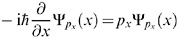
One simple question that can be asked is what is the state function for a particle of mass m moving in free space with a constant velocity v x or linear momentum p x = mv x. Based on the discussion in connection with Eqs. (2.15a) and (2.15b), this state function must be the eigen function corresponding to the eigen value p x, which can be of a positive or negative value, of the operator
x representing the x component of the linear momentum:
| (3.1) | |
Following Corollary 2 of Postulate 2 or as a necessary consequence of the commutation relationship (2.11a), (3.1) becomes a simple ordinary differential equation in the Schr dinger representation:
| (3.2) | |
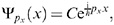
with the solution
| (3.3) | |
where C is a constant to be determined by the normalization condition. Since the particle is in free...