Fundamentals of Quantum Mechanics: For Solid State Electronics and Optics

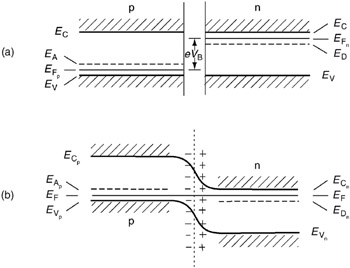
When the p-type and n-type doped semiconductors of the same kind (Figure 10.9(a)) are brought into contact to form a p n junction (Figure 10.9(b)), because of the difference in the Fermi levels, or the chemical potentials, charge-carriers will flow from one side to the other, leaving spatially fixed ionized donors and acceptors behind, which results in a built-in electrical potential difference across the junction. Such a p n junction is of great technological importance.
The Fermi Dirac distribution functions, (10.27) and (10.28), show that the carrier concentrations in the semiconductor are determined by the local chemical potential. At a p n junction, before there is any transfer of charges from one side to the other, both sides are electrically neutral. The states of the same energy relative to the top of the valence band on the two sides of the junction can, however, have very different electron or hole populations because of the difference in the chemical potentials (Figure 10.9(a)). When the two sides are brought together and forma perfect junction, as a result of the concentration gradients of the conduction band electrons and the valence band holes, charge-carriers will move across the junction. Conduction band electrons will diffuse across the junction from the n-side to the p-side to be trapped by the acceptors on the p-side and leave positively charged ionized...