Fundamentals of Quantum Mechanics: For Solid State Electronics and Optics

The harmonic oscillator is a model for many physical systems of scientific and technological importance. It describes the motion of a bound particle in a potential well that increases quadratically with the distance from the minimum or the bottom of the potential well. Quantum mechanically, Heisenberg s equation of motion for the position of such a particle is of the same form as that of a classical harmonic oscillator. As such, it is a model for any physical system whose natural motion is described by the harmonic oscillator equation, such as the vibrational motion of molecules, lattice vibrations of crystals, the electric and magnetic fields of electromagnetic waves, etc. Quantization of the electromagnetic waves leads to the concepts of photons and coherent optical states. The eigen functions and quantized energies of harmonic oscillators in general share some general features with those of the square well potential considered in the previous chapter.
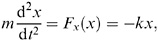
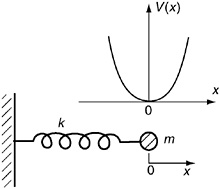
Consider the case of a point mass, m, attached to the end of a linear spring with a spring constant k (Figure 5.1). The classical equation of motion of the particle is:
| (5.1) | |
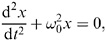
where x is the deviation of the position of the mass point from its equilibrium position. It can be put in the form of the harmonic oscillator equation:
| (5.2) | |
where
is the angular frequency of the oscillator.