Fundamentals of Quantum Mechanics: For Solid State Electronics and Optics

An electron in a hydrogenic atom or ion can occupy any of the n ?sjm j
eigen states of the Hamiltonian of the atom or ion. In ions or atoms with more than one electron, the solutions of the time independent Schr dinger equations become complicated because the electrons interact not only with the positively charged nucleus, but also with each other. Particles with half-integer spin angular momentum, such as electrons, must also satisfy Pauli s exclusion principle, which forbids two such particles to occupy the same quantum state. Furthermore, the electrons in the multi-electron ion or atom are indistinguishable from one another. Taking these considerations into account, the electrons will systematically fill all the available single-electron states of successively higher energies in multi-electron ions or atoms. Because of the nature of the quantum states occupied by the electrons, the physical and chemical properties of the elements exhibit certain patterns and trends which form the basis of the periodic table.
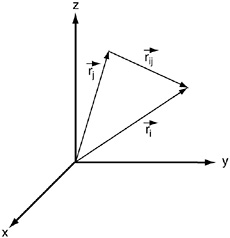
Consider an ion with N electrons and Z protons in the nucleus; for a neutral multi-electron atom, Z = N. Again, because the nucleus is much heavier than the electrons, we assume it to be stationary at the origin of a spherical coordinate system, as shown in Figure 7.1.
Including only...