Going beyond the motion of particles in free space considered in the previous chapter, the dynamics of particles subject to various forces, or more appropriately in the language of quantum mechanics under the actions of potentials of various forms, are studied in this chapter. They include: a simple boundary, potential steps, potential barriers, and quantum wells. Even with such simple models, new and practically important quantum phenomena will show up. These include the quantum mechanical reflection and transmission effects; the quantum mechanical tunneling effect, which is the basis for the practically important tunnel diode, for example; the appearance of bound states in quantum wells, which have the same origin as the quantized energy levels in atoms, molecules, and ultimately the states of electrons, or the band structures in semiconductors; etc. The latter lead to devices such as transistors and diode lasers.
4.1 Boundary Conditions and Probability Currents
More important than particles moving in free space are the dynamics of particles subject to various forces, or in regions of different potentials.
Let us consider first a simple one-dimensional problem. A beam of particles moving with a constant initial velocity v 0, or kinetic energy 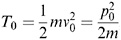 , in Region I is incident on a simple boundary (at x = 0) separating two constant potential-energy regions:
| (4.1) | 
|
V > can be positive (+ V 0) or negative ( ? V 0) corresponding to a potential step up or down. What will happen to the state of the particles passing...
Copyright Cambridge University Press 2005 under license agreement with Books24x7


 TABLE OF CONTENTS