Fundamentals of Quantum Mechanics: For Solid State Electronics and Optics
10.5: Fermi Dirac Distribution Function and the Chemical Potential

10.5 Fermi Dirac Distribution Function and the Chemical Potential

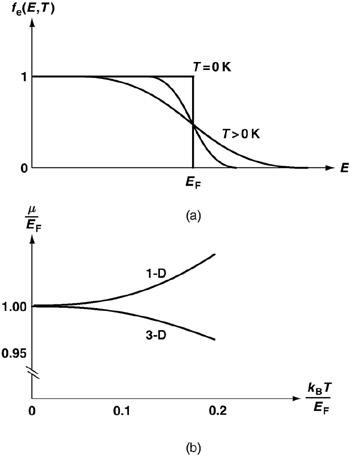
In the limit of 0 K temperature, all the electrons in the solid will occupy the lowest possible energy state, subject to the Pauli exclusion principle. The corresponding distribution function as a function of energy is shown in Figure 10.6(a). It is equal to one up to the Fermi energy and drops to zero above the Fermi energy.


Figure 10.6: (a) Fermi Dirac distribution functions at T = 0 K and at two T > 0 K. (b) Dependence of the chemical potential on the temperature T for one-dimensional (1-D) and three-dimensional (3-D) systems.

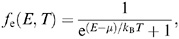
At a finite temperature, some of the electrons will be excited to states above the Fermi energy. The probability that a given energy state is occupied by fermions follows the Fermi Dirac distribution function :

(10.27)

where K B is the Boltzmann constant and is equal to 1 .38 10 ?16 erg / K. is...

UNLIMITED FREE
ACCESS
TO THE WORLD'S BEST IDEAS

SUBMIT
Already a GlobalSpec user? Log in.

This is embarrasing...

An error occurred while processing the form. Please try again in a few minutes.

Customize Your GlobalSpec Experience

Category: Oxidation Reduction Potential (ORP) Instruments
Finish!
Privacy Policy

This is embarrasing...

An error occurred while processing the form. Please try again in a few minutes.