Fundamentals of Quantum Mechanics: For Solid State Electronics and Optics
The study of interaction of electromagnetic radiation with atoms played a crucial role in the development of quantum mechanics and forms the basis of such important fields of study as spectroscopy, quantum optics, electro-optics, and many important modern devices, such as photo-detectors and lasers. Because the electromagnetic fields acting on the atom are time-varying parameters, the corresponding Schr dinger equation is a partial differential equation with time-varying coefficients. As such, it can only be solved by approximate methods, in general. The standard technique of time-dependent perturbation theory for solving such problems is introduced in this chapter. The absorption and emission processes due to electric dipole interaction of atoms with electromagnetic radiation and the related transition probabilities and selection rules can be understood on the basis of the first order perturbation theory. An important application of the theory is the process of Light Amplification by Stimulated Emission of Radiation (LASER).
For the present discussion, we consider the electric dipole interaction of an atom with a monochromatic transverse electromagnetic wave with a wavelength ?, long compared with the spatial extent of the atom. It is assumed that the electric field of the wave is a known applied field of the form:
| (8.1) | |
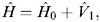
and is not modified by its interaction with the atom. Thus, the Hamiltonian of the atom in the field is of the form:
| (8.2) | |
where V 1 is the electric dipole interaction energy between the atom and...