Fundamentals of Quantum Mechanics: For Solid State Electronics and Optics
10.7: n-type and p-type Extrinsic Semiconductors

10.7 n-type and p-type Extrinsic Semiconductors

When some of the group IV atoms in a IV IV intrinsic semiconductor crystal, such as Si or Ge, are substituted by group V or III atoms, such as As or Ga, these impurity atoms can act as donors or acceptors, respectively, of electrons in the extrinsic semiconductor.

If a group IV atom is substituted by a group V atom with five valence electrons, the s and p valence-orbitals of the V atom will form four sp 3 orbitals of a tetrahedral complex and bond with the group IV atoms as a part of the diamond lattice of the extrinsic crystal. Four of the five valence electrons of the group V atom will occupy these valence-bond states; the one remaining valence electron will be loosely bound to the positively charged impurity V-ion as a hydrogenic atom with a relatively small ionization energy compared to the band gap of the semiconductor. The potential due to the positively charged nucleus of this impurity ion in the host lattice experienced by this loosely attached electron in the hydrogenic model of this dopant is approximately a Coulomb potential in a dielectric medium; it is, therefore:

(10.49)

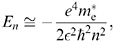
where is the dielectric constant of the host crystal. The corresponding energy levels of the hydrogenic ion are then, from (6.37):

(10.50)
...

UNLIMITED FREE
ACCESS
TO THE WORLD'S BEST IDEAS

SUBMIT
Already a GlobalSpec user? Log in.

This is embarrasing...

An error occurred while processing the form. Please try again in a few minutes.

Customize Your GlobalSpec Experience

Category: Semiconducting Materials
Finish!
Privacy Policy

This is embarrasing...

An error occurred while processing the form. Please try again in a few minutes.