Geotechnical and Foundation Engineering: Design and Construction
The following notation is used in this chapter:
| SYMBOL | DEFINITION |
| a max | Peak acceleration at the ground surface | |
| C b | SPT correction factor to account for the borehole diameter | |
| C N | SPT correction factor to account for the vertical effective stress | |
| C r | SPT correction factor to account for the drilling rod length | |
| E m | SPT correction factor to account for the hammer efficiency | |
| g | Acceleration of gravity | |
| M | Earthquake magnitude | |
| N 60 | SPT N- value corrected for field testing procedures | |
| (N 1) 60 | SPT N- value corrected for both field testing procedures and ? ? ?0 | |
| r d | Depth reduction factor | |
| W | Weight of the sliding mass | |
| z | Depth below ground surface | |
| ? ?0 | Total vertical stress | |
| ?? ?0 | Vertical effective stress |
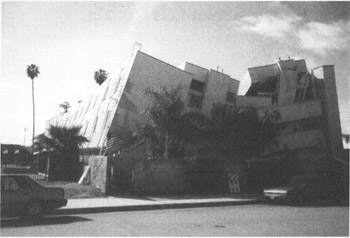
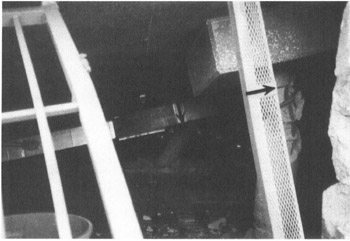
Chapter 11 presents a brief discussion of earthquakes. A structure could be damaged by the seismic energy of the earthquake or actual rupture of the ground due to fault movement. Other problems caused by the ground shaking from earthquakes include the settlement of loose soil, slope movement or failure, and liquefaction of loose granular soil below the groundwater table. Figures 11.1 and 11.2 show the collapse of an apartment building during the Northridge, California, earthquake caused by the weak shear resistance of the first floor garage area.