Geotechnical and Foundation Engineering: Design and Construction

Part 4: Performance or Engineering Evaluation of Construction

Chapter List

Chapter 17: Grading
Chapter 18: Construction Services

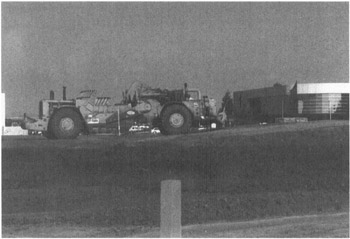
A scraper, used for both the excavation and compaction of fill.

OVERVIEW

The following notation is used in this chapter:

SYMBOL

DEFINITION

G

Bulk specific gravity of oversize particles

M ds

Dry mass of the matrix soil

M o

Mass of the oversize particles

RC

Relative compaction

s

Standard deviation

V

Total volume of the excavated hole (sand cone test)

w

Water content (also known as the moisture content)

w opt

Optimum water content, also known as the optimum moisture content

? a

Average value of the laboratory maximum dry density

? d

Field dry density

? dm

Dry density of the matrix material

? d max

Laboratory maximum dry density

? s

Density of soil particles

? w

Density of water

17.1 INTRODUCTION

Chapters 6 through 16 (Part 3 of the book) deal with the analysis of geotechnical data and engineering computations. As indicated in Fig. 1.11, Part 4 of the book (Chaps. 17 and 18) deals with the performance or engineering evaluation of construction. At this stage of the project, the subsurface exploration, laboratory testing, and engineering analysis for the project are complete. Normally, the geotechnical engineer and engineering geologist will prepare a report presenting the results of the subsurface investigation and design recommendations as required for the project. These types of reports are often known as preliminary or feasibility reports. In many cases, the...

UNLIMITED FREE
ACCESS
TO THE WORLD'S BEST IDEAS

SUBMIT
Already a GlobalSpec user? Log in.

This is embarrasing...

An error occurred while processing the form. Please try again in a few minutes.

Customize Your GlobalSpec Experience

Category: Geotechnical Services
Finish!
Privacy Policy

This is embarrasing...

An error occurred while processing the form. Please try again in a few minutes.