Geotechnical and Foundation Engineering: Design and Construction

The following notation is used in this chapter:
| SYMBOL | DEFINITION |
| A | Soil loss (universal soil loss equation) | |
| C | Vegetative cover factor (universal soil loss equation) | |
| E | Storm energy | |
| H | Height of the slope | |
| I 30 | 30-minute rainfall intensity | |
| K | Soil erodibility factor (universal soil loss equation) | |
| L | Length of slope in feet | |
| L ? | Length factor [Eq. (12.3)] | |
| m | Exponent for Eq. (12.3) | |
| P | Erosion control practice factor (universal soil loss equation) | |
| R | Rainfall erosion index (universal soil loss equation) | |
| s | Slope steepness, expressed as a percentage | |
| S | Combined slope length and steepness factor (universal soil loss equation) | |
| ? | Slope inclination |
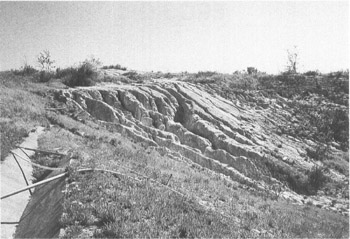
The process of slope erosion can begin as slopewash. The term slopewash refers to a form of erosion in which water moves as a thin and relatively uniform film (Rice, 1988). With time, the flow of water may concentrate into a series of slightly deeper pathways (called rills), and this is known as rillwash. With continued erosion, gullies could emerge and ultimately there could be the formation of channeled stream flow through the slope. Table 12.1 lists five levels of slope erosion and Fig. 12.1 shows severe erosion of a slope.
| Level of erosion (1) | Classification (2) | Description (3) |
|---|---|---|
| 1 | Very slight | Minor erosion; at the... |