Handbook of Adhesives and Sealants
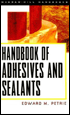
Covering structural and non-structural applications, this handbook lets you thoroughly explore the use of polymeric adhesives and sealants for joining or bonding metals, plastics, composites and elastomers.
 TABLE OF CONTENTS
 Since adhesives and sealants must function by surface attachment, the nature and condition of the substrate surface are critical to the success of any bonding or sealing operation. Four common criteria are generally recognized for an ideal bonding surface: cleanliness, continuity, stability, and wetting of the surface by the adhesive or sealant.
Cleanliness does not necessarily mean the absence of all surface films, since some surface films are very strongly attached to the bulk substrate and offer a suitable surface for adhesion. However, cleanliness does require the removal of unwanted or weak boundary layers such as oil, dirt, or corrosion. The purpose of cleaning the surface is to remove any weakly attached materials and to provide a surface that is relatively consistent from part to part.
Discontinuities on the adherend surface, whether chemical or physical, may adversely affect the apparent strength of the joint by creating localized regions of poor bonding and stress concentration within the joint. Discontinuities may also make surface cleaning or treating processes non-homogeneous. These discontinuities could be due to inconsistent manufacturing processes or chemical inhomogeneity within the substrate.
Stability of the substrate surface is important before bonding as well as after bonding. Unwanted boundary layers could form during the time between surface preparation and application of the adhesive, depending on the shop environment and the reactivity of the surface. Boundary layers could also form during the time period after the adhesive is applied and before it sets, depending on the reactivity of the surface...