Handbook of Adhesives and Sealants
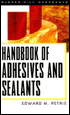
Covering structural and non-structural applications, this handbook lets you thoroughly explore the use of polymeric adhesives and sealants for joining or bonding metals, plastics, composites and elastomers.
 TABLE OF CONTENTS
 The various generic families of sealant materials are reviewed in this chapter. Properties and performance characteristics are presented although they can vary considerably within each family. There are over 15 families of polymers that are used singly or in blends to achieve the storage characteristics, application properties, physical performance, and durability required for each application. Table 13.1 shows some of the strengths and weaknesses of the most popular synthetic based sealant families.
| Chemical family and curing type | Strengths | Weaknesses |
|---|---|---|
| Silicones, one component (moisture-initiated condensation) and two components (condensation or addition) | Best weathering, highest flexibility good adhesion, heat resistance | High MVTR, low depth of cure, slow curing [b] |
| Polyurethanes, one component (moisture-initiated condensation) and two components (condensation) | Good weathering, best adhesion, high flexibility | Weak UV resistance, weak heat resistance |
| Polysulfides, one component (moisture-initiated condensation) and two components (condensation) | Low MVTR [a], fuel resistant, good flexibility | Slow curing [b], low depth of cure |
| Acrylic latex (water evaporation) | Easy to use | High shrinkage, poor weathering, fair flexibility |
| Butyls (sulfur vulcanization) | Lowest MVTR, good flexibility | Fair weathering |
| Anaerobics (metal/peroxide initiated free radical) | Fast curing, chemical resistant, heat resistant | Brittleness, poor gap filling |
| Vinyl plastisols (heat fusion) | Good adhesion, low cost | Fair flexibility, fair weathering |
| Asphalts/coal tar resins (cooling oxidation) | Low cost, fuel resistant | Poor weathering |
| Polypropylene hot melts (cooling) | Low cost, expandable | Limited adhesion, fair flexibility |
| [b]Two-component version cures faster. [a]MVTR, moisture vapor transmission rate. |
The following sections describe the characteristics...