Handbook of Adhesives and Sealants
Covering structural and non-structural applications, this handbook lets you thoroughly explore the use of polymeric adhesives and sealants for joining or bonding metals, plastics, composites and elastomers.
 TABLE OF CONTENTS
 Some adhesives and sealants may provide only marginal adhesion to certain substrates. This could be due to the low surface energy of the substrate relative to the adhesive (e.g., epoxy bonding polyethylene) or to a boundary layer that is cohesively weak (e.g., powdery surface on concrete). The substrate may also be pervious, allowing moisture and environmental chemicals to easily pass through the substrate to the adhesive interface, thereby degrading the bond's permanence. Generally, attempts are made to overcome these problems through adhesive formulation and by substrate surface treatments. When these approaches do not work, additional bond strength and permanence may possibly be provided by primers or adhesion promoters.
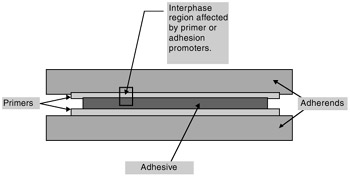
Primers and adhesion promoters work in a similar fashion to improve adhesion. They add a new, usually organic, layer at the interface such as shown in Fig. 7.1. The new layer is usually bifunctional and bonds well to both the substrate and the adhesive or sealant. The new layer is very thin so that it provides improved interfacial bonding characteristics, yet it is not thick enough so that its bulk properties significantly affect the overall properties of the bond.
Both primers and adhesion promoters are strongly adsorbed onto the surface of the substrate. The adsorption may be so strong that instead of merely being physical adsorption, it has the nature of a chemical bond. Such adsorption is referred to as chemisorption to distinguish...