Handbook of Adhesives and Sealants
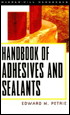
Covering structural and non-structural applications, this handbook lets you thoroughly explore the use of polymeric adhesives and sealants for joining or bonding metals, plastics, composites and elastomers.
 TABLE OF CONTENTS
 All metals have a relatively high surface energy and are generally considered easy to bond. However, there are several problems that could occur when working with metallic substrates. One difficulty in bonding metals is the durability of the joint. It is not so much a problem of making a strong joint as one of keeping it that way throughout its expected service life. A weld may have a strength of only 600 lbs, but it is likely to remain that strong for 5 10 years afterward. An adhesive, on the other hand, may have three to four times the initial strength of a weld, but it could weaken when exposed to high humidities, cycled between hot and cold temperatures, or immersed in salt water and then dried. By definition, a structural adhesive must be able to withstand such conditions without significant deterioration.
A second difficulty in bonding metals is understanding the nature of the surface. One of the important points to consider when bonding metals is that only the surfaces are involved. Adhesives and sealants are active only on that top molecular surface layer and on any surfaces contained in the porosity of the metal itself. Thus, if unprepared steel is being bonded, it is not the bulk iron/carbon alloy that is being bonded, but the iron oxide layer on the surface (presuming that the metal surface was cleaned of organic contaminants). Similarly with aluminum, the actual bond is to aluminum oxide rather than the pure metal.
The...