Hands-on Electronics: A One-Semester Course for Class Instruction or Self-Study

In this chapter you will become acquainted with the workhorses of electronics testing and prototyping: multimeters, breadboards, and oscilloscopes. You will find these to be indispensable aids both in learning about and in doing electronics.
One dual-trace oscilloscope, one powered breadboard, one digital multimeter, two 10X attenuating scope probes, red and black banana leads, two alligator clips.
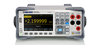
You are probably already familiar with multimeters. They allow measurement of voltage, current, and resistance. Just as with wristwatches and clocks, in recent years digital meters (commonly abbreviated to DMM for digital multimeter or DVM for digital voltmeter) have superseded the analog meters that were used for the first century and a half or so of electrical work. The multimeters we use have various input jacks that accept banana plugs, and you can connect the meter to the circuit under test using two banana-plug leads. The input jacks are described in Table 1.1. Depending on how you configure the meter and its leads, it displays
the voltage difference between the two leads,
the current flowing through the meter from one lead to the other, or
the resistance connected between the leads.
| Input jack | Purpose | Limits [a] |
|---|---|---|
| COM | reference point used for all measurements | |
| V ? | input for voltage or resistance measurements | 1000 V DC/750 V AC |
| mA | input for current measurements (low scale) | 200 mA |