Hands-on Electronics: A One-Semester Course for Class Instruction or Self-Study

In Chapter 7 we studied some of the basic properties of operational amplifiers. There are an enormous number of ways that op amps can be applied to process analog signals. In this chapter we will explore several such applications: circuits that differentiate or integrate their input voltage as a function of time, form the logarithm or exponential of their input voltage, or rectify their input voltage. The op amp versions of these applications come closer to the ideal than the passive versions of some of them that you studied in earlier chapters. We will also see how to use feedback to compensate for the limitations of discrete devices.
Breadboard, dual-trace oscilloscope with two attenuating probes, one 741C and one LF411 operational amplifier, one 1 k, two 10 k, and one 100 k 1/4 W resistor, 0.0047 F and 0.033 F capacitors, two 1N914 (or similar) silicon signal diodes, 2N3904 and 2N3906 transistors.
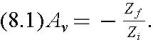
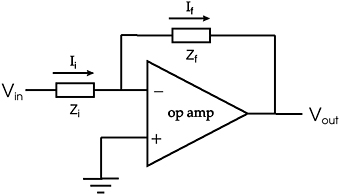
Recall that for an inverting amplifier made from an op amp, with input resistor R i and feedback resistor R f, the gain is ? R f /R i (neglecting the input offset voltage and offset and bias currents and taking the op amp open-loop gain to be infinite). We can generalize this result for devices other than resistors, as illustrated in Fig. 8.1.
Eq. 8.1 is useful if we are analyzing circuit performance in the frequency-domain for a sine-wave input, but often...