Hands-on Electronics: A One-Semester Course for Class Instruction or Self-Study

4.2: Experiments

4.2 Experiments

4.2.1 Checking transistors with a meter

Since a transistor is constructed as a pair of back-to-back PN junctions, a quick way to test a transistor is to verify its junction resistances in the forward- and reverse-biased directions. Often this can be done using an ohmmeter, which sends current through the device under test and measures the resulting voltage. However, our digital multimeters are not designed for this kind of measurement; instead, they provide a diode test function that measures the forward voltage corresponding to a forward current of about 600 A. To test a diode or transistor junction, connect it between the V ? and common jacks with clip leads and set the meter s selector knob to the position marked with the diode symbol. The diode is forward-biased if its anode is connected to V ? and its cathode to common .

  • Test the base collector and base emitter junctions of a 2N3904 (NPN) and 2N3906 (PNP), and record your readings in both the forward- and reverse-biased directions.

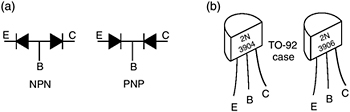
To tell which pin of the transistor is which, refer to Fig. 4.4, which shows the pinout for the TO-92 plastic case in which these transistors are packaged. If your transistors are good, each junction should show about 700 mV in the forward direction, and an out-of-range indication in the reverse direction.


Fig. 4.4: Transistor as back-to-back diodes; TO-92 pinout.

4.2.2 Emitter follower

This simple transistor circuit (shown in Fig. 4.5(a)) is often used to buffer an AC signal,...

UNLIMITED FREE
ACCESS
TO THE WORLD'S BEST IDEAS

SUBMIT
Already a GlobalSpec user? Log in.

This is embarrasing...

An error occurred while processing the form. Please try again in a few minutes.

Customize Your GlobalSpec Experience

Category: Unijunction Transistors (UJT)
Finish!
Privacy Policy

This is embarrasing...

An error occurred while processing the form. Please try again in a few minutes.