In many freshman-physics textbooks, the frequency-domain analysis of RC circuits is not explicitly treated; however, it is not particularly difficult. Here is a detailed derivation.
At any moment of time, the charge Q stored on the capacitor is proportional to the voltage V C across it:
If the voltage across the capacitor is varying sinusoidally in time, it follows that the charge must also vary sinusoidally. Then, since the current I flowingonto one plate of the capacitor is the time derivative of the stored charge, the current must also be a sinusoidal function, but out of phase with the voltage by 90 (since the derivative of the sine is the cosine, which is out of phase with the sine by 90 , and the derivative of the cosine is minus the sine).
Now consider a series RC circuit being driven by a sinusoidal AC voltage source (Fig. C.1). Since the resistor and capacitor are in series, they must have the same current flowingthrough them; however, it is not necessarily in phase with the source voltage, V. Suppose (for the sake of definiteness) that
i.e. we have chosen the zero of time to be a moment when the voltage across the source is zero. Then, allowingfor an unknown phase difference between the current in the circuit and the voltage applied by the source, we can write
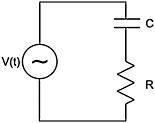 Fig. C.1: Series RC circuit.
 Kirchhoff s voltage law tells us that, at any moment of time, the applied voltage must...
Copyright Cambridge University Press 2003 under license agreement with Books24x7


 TABLE OF CONTENTS