4.4 Normal Modes and Dynamical Matrix
Along the lines developed in Section 4.1, in three-dimensional lattice-dynamics calculations, a frequency-space description is used for the motions of the atoms. Instead of the localized motions of individual atoms, the system is described by energy waves with given wave vector ?, frequency ?, and polarization vector e ?. The formulation of lattice-dynamics theory is described in [9] and [360].
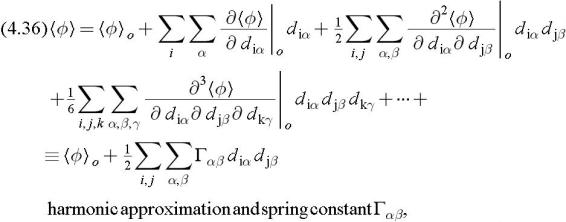
For an equilibrium potential energy, defined by (2.47), of a system with N atoms that is designated by ? ? ? o, atom i is moved by an amount d i, and the resulting energy of the system, ? ? ?, the total potential energy, is found by a Taylor series expression around the equilibrium state (small displacement of all atoms) as
where the i, j, and k sum over the atoms in the system (when including anharmonicity, for third-order interactions and for pair potentials, i = j = k or i = j or j = k), and the ?, ?, and ? sums are over the x, y, and z directions, as shown in Figure 2.12(d). Both ? ? ? and ? ? ? o are only functions of the atomic positions. The first derivative of the potential energy with respect to each of the atomic positions is the negative of the net force acting on that atom. Evaluated at...


 TABLE OF CONTENTS