4.8 Atomic Displacement in Lattice Vibration
In Section 2.5.3(B), the RMS displacement of lattice atoms was given by approximation (leading-order) relation (2.56). Here we derive a general expression, based on the treatment given in [23].
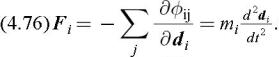
Consider a polyatomic molecule; based on the Newton law (Table 2.5) the force on atom i, F i, is
With the harmonic approximation for the potentials and for small displacements, we have [similar to (4.37)]
Then equation of motion (4.39) is again
where s ? is a polarization vector, M is the mass matrix, and D ( ? ) is the dynamical matrix (4.40)
Rearranging (4.78), the eigenvalue equation becomes
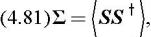
where I is the identity matrix. Here D( ?) is specified by a complete set of internal displacement coordinates, including bond lengths and angle displacements. This set of coordinates can be represented by a column matrix S [23]. The mean-square relative displacement (MSRD) amplitude matrix ? is defined as
where S is chosen such that the diagonal elements of ? of the MSRD of the atomic vibrations satisfy ? ? j 2 ? = ? jj. The superscript indicates complex conjugate. The coordinate S may be not normal, but we may find a matrix L to transform S to the normal coordinates Q (Glossary), i.e.,
Then we have
When Q satisfies
then we have the relations [81]
In the high-temperature regime (within harmonic...


 TABLE OF CONTENTS