Overview
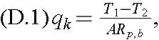
At a solid solid (two semi-infinite media) interface (plane-parallel geometry), the net conduction heat flux q k that is due to the difference of temperature between T 1 and T 2, assumed uniform in each (semi-infinite medium), for phonons on each side of the interface is [268, 322]
where R p,b is the phonon boundary resistance. This resistance is determined by the number of phonons incident upon the interface, the energy carried by each phonon, and the probability of transmission across the interface.
The transmission probability ? b depends on the side from which phonons arrive at the interface, angle of incidence, phonon frequency, phonon polarization, and T 1 and T 2. Using an analogy with blackbody radiation, we have
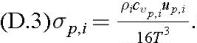
where ? p,i is the phonon Stefan Boltzmann constant, given by (Section)
For T 1 = T 2, then q k = 0, and
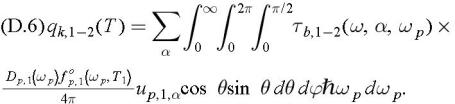
i.e., under thermal equilibrium, the total number of phonons (sum over all phonon states, polarization ? and frequency ? p) leaving one side, is equal to the total number of phonons returning from the other side into that state (called the principle of detailed balance). From this, we define q k, 1-2( T 1) and q k, 1-2( T 2) for the incident phonons at temperatures T 1 and T 2, and write
Using the equilibrium distribution of thermal phonons, we have
The second part inside the integral...


 TABLE OF CONTENTS