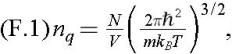
The Fermi Dirac (fermion) and Bose Einstein (boson) statistics include quantum effects and apply to interacting, indistinguishable particles (Table 1.2). The M B statistics apply to noninteracting indistinguishable particles (classical particles), whose wave functions do not overlap and quantum effects vanish (footnote of Section 2.6.5). When the particle concentration is much less than the quantum limit, quantum effects will vanish and all the particles can be treated as classical particles. The ratio of the particle concentration and the quantum limit is called the quantum concentration (footnote of Section) n q, which is defined by
where N is the number of particles, V is the volume of the system, m is the mass of the particle, and T is the temperature. Therefore both fermions and bosons become the M B statistics at high temperatures or low concentrations.
Derivation of the particle (including quantum) statistics distribution functions are given in [119, 239].
F.1 Partition Functions
For different ensembles [Section 2.5.1(A)], the partition function may have different forms. For a canonical ensemble, the partition function (2.27) is defined as
where j designates the energy state of the system.
For a grand canonical ensemble ( ?VT), the partition function is defined as
where N is the number of particles, and when it is a constant, then ? = 0, and Z( ?, V, T) becomes Z( N, V, T), relating (F.2) and (F.3).
The partition function (F.2) and (F.3) can be simplified...
Copyright Massoud Kaviany 2008 under license agreement with Books24x7


 TABLE OF CONTENTS