Heat Transfer Physics

Appendix C: Derivation of Minimum Phonon Conductivity Relations

C.1 Einstein Thermal Conductivity

The derivation presented in this section and the next is based on that given in [100, 52], with some of the mathematical steps given in more detail. The formulation of the Einstein thermal conductivity, k E, presented here is that given in [232], which is extended to arrive at the C P high scatter limit, k CP, in Section C.2.

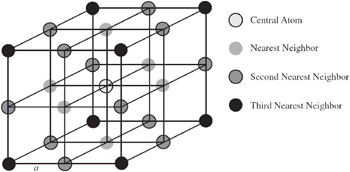
In the Einstein approach, the vibrational states do not correspond to phonons, but to the atoms themselves, which are assumed to be on a simple cubic lattice as shown in Figure C.1. As will be discussed, the choice of the crystal structure does not affect the final result. Each atom is treated as a set of three harmonic oscillators in mutually perpendicular directions. Although the atomic motions are taken to be independent, an atom is assumed to exchange energy with its first, second, and third nearest neighbors. The coupling is realized by modeling the atomic interactions as being a result of linear springs (with spring constant ?) connecting the atoms. A given atom has 6 nearest neighbors at a distance of a, 12 second-nearest neighbors at a distance of 2 1/2 a, and 8 third-nearest neighbors at a distance of 3 1 / 2 a.


Figure C.1: The simple cubic crystal structure, with the first-, second- and third-nearest neighbors of the central atom shown.

The derivation starts from the equation written in terms of the mean free path (4.109) ( k

UNLIMITED FREE
ACCESS
TO THE WORLD'S BEST IDEAS

SUBMIT
Already a GlobalSpec user? Log in.

This is embarrasing...

An error occurred while processing the form. Please try again in a few minutes.

Customize Your GlobalSpec Experience

Category: Nanomaterials
Finish!
Privacy Policy

This is embarrasing...

An error occurred while processing the form. Please try again in a few minutes.