Heat Transfer Physics

4.9: Phonon BTE and Callaway Conductivity Model

4.9 Phonon BTE and Callaway Conductivity Model

4.9.1 Single-Mode Relaxation Time

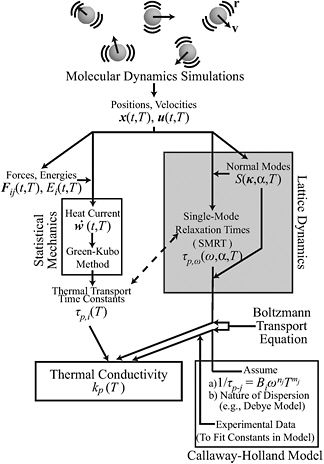
The single-mode relaxation time (SMRT) for a mode in a phonon system describes the temporal response of the system when that mode is excited and all other modes have their equilibrium populations. This is used in the BTE derivation of the phonon conductivity, as outlined in Figure 4.14. SMRT can be seen as being consistent with an exponential decay of the energy autocorrelations (Table 3.9) using the Green Kubo theory for thermal conductivity (Section 3.6 and will also be discussed in Sections 4.12-4.13). The limitation of this approach is that the underlying assumption (one mode activated and others at equilibrium) is never realized. This is because the natural decay of the energy in a mode occurs in the presence of other modes that are excited or diminished.


Figure 4.14: The methods of prediction of phonon thermal conductivity, MD and BTE (Callaway Holland) [233]. The relaxation time ? p ? j has a frequency dependence and temperature dependence .

In SMRT approximation, each phonon mode ? has a single, effective phonon relaxation time ? p = ? p ( ? p , ?,T) representing the various scattering mechanisms.

4.9.2 Callaway Phonon Conductivity Model from BTE

The derivation presented in this section is based on that given by Callaway [53] and Holland [151]. The method presented can be applied to either a quantum or classical system.

The heat flux generated by a change in the...

UNLIMITED FREE
ACCESS
TO THE WORLD'S BEST IDEAS

SUBMIT
Already a GlobalSpec user? Log in.

This is embarrasing...

An error occurred while processing the form. Please try again in a few minutes.

Customize Your GlobalSpec Experience

Category: Time Division Multiplexers (TDM)
Finish!
Privacy Policy

This is embarrasing...

An error occurred while processing the form. Please try again in a few minutes.