Hydraulics Field Manual, Second Edition
Section 10: Well Design Considerations

Most municipal water systems and over 90% of the rural population receive potable water from wells that are tapped into water bearing aquifers.

10.1 Aquifers

The primary water source is from rain and snow-melt that is infiltrated and percolated down into water bearing aquifers, often far removed from the original source. Refer to Figure 10-1 for a graphic illustration. Section 3 gives a more detailed description of groundwater.


Figure 10.1: Cross-section of an artesian aquifer. ( Reprinted from Water Distribution Operator Training Handbook, by permission. Copyright 1999, American Water Works Association.)

10.2 Drilled Wells

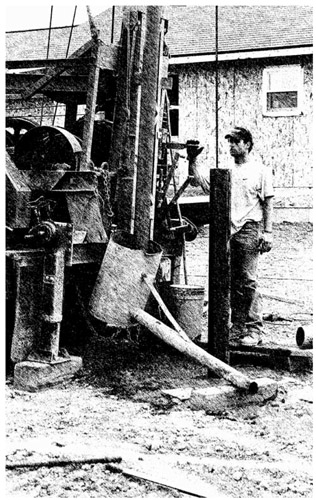
Drilled wells are by far the most common type of construction for public and private water supplies. Their depth varies greatly from a few feet to several thousands of feet. Drilling methods vary because of site specific conditions. Some of the more typical methods are driven points, cable tool, rotary air and rotary hydraulic. Each method utilizes equipment to pierce or penetrate the existing soil, sand, gravel, cobbles or rock and transport the drilling debris to the surface.

Generally, a steel casing is installed to the proper depth. Then a well screen is inserted and lowered to the water bearing aquifer at which point the casing is retracted enough to expose the screen as shown in Figure 10-2. If the water source contains fines or silty material, it is almost impossible to keep these tiny particles from entering the pumping system. Therefore, the screen must be reinforced by surrounding it with a gravel pack.

UNLIMITED FREE
ACCESS
TO THE WORLD'S BEST IDEAS

SUBMIT
Already a GlobalSpec user? Log in.

This is embarrasing...

An error occurred while processing the form. Please try again in a few minutes.

Customize Your GlobalSpec Experience

Category: Casing (borehole)
Finish!
Privacy Policy

This is embarrasing...

An error occurred while processing the form. Please try again in a few minutes.