Hydrodynamics and Sound

Providing a detailed study of a wide range of highly simplified model problems,' this book presents the most important theoretical methods that will enable the reader to develop analytical models of practical significance.
 TABLE OF CONTENTS
An ideal fluid is inviscid and does not conduct heat. If the fluid is incompressible and of uniform density ? o the motion is governed by the continuity and momentum equations:

If the fluid is compressible we shall generally assume also that it is homentropic, with s = s o = constant. Then ? = ?( p, s o) may be regarded as a function of the pressure alone. When the explicit dependence on s o is suppressed, the equations of motion are

The order of magnitude of the ratio of the pressure and Reynolds stress terms to the viscous stresses in the Navier Stokes equation ~Re = ? ?/v, where ? and ? are characteristic velocities and length scales, respectively, of the problem at hand, v = ?/ ? is the kinematic viscosity, and Re is called the Reynolds number. The ideal fluid approximation requires at the very least that Re  1, although it may not be possible to satisfy this condition at all points of the flow.
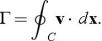
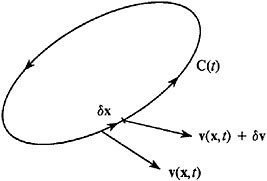
Let C be a closed material contour drawn in the fluid (Fig. 2.2.1); this moves with the fluid and therefore always passes through the same fluid particles. The circulation ? around C is defined by
Stokes theorem permits this to be expressed in terms of the vorticity:

where S is any two-sided surface bounded by C,...