Hydrodynamics and Sound

Providing a detailed study of a wide range of highly simplified model problems,' this book presents the most important theoretical methods that will enable the reader to develop analytical models of practical significance.
 TABLE OF CONTENTS
The mathematical treatment of dispersive waves depends on specialised methods involving Fourier transforms and is closely related to the notion of group velocity. It provides a simple description of how, for example, an initially coherent free surface wave profile evolves with position and time because of the different phase velocities ( c = ?/k) of the different wavenumber components in the Fourier integral representation of the initial profile. To facilitate the solution of such problems by Fourier transforms it is convenient to adapt the formal method of 2.8 by introducing the Heaviside step function H( t) in order to transform the initial-value problem into one defined over all times ? ? < t < ?. The procedure will first be described in detail.
Suppose an elevated section of the free surface of water of infinite depth is released from rest at t = 0 (Figure 5.5.1). To fix ideas let

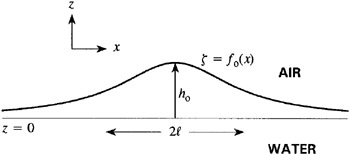
The subsequent motion is described by a velocity potential ? that satisfies Laplace s equation  , subject to the following form of surface condition (5.1.5):

Multiplying by H( t) we find, using the free surface relation ? ?/ ?t = ? g ?,
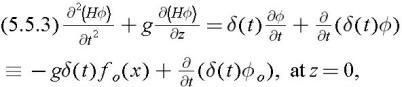
where ? o is the velocity potential at t = 0 and H ? H( t). The quantities ? o and f o( x) respectively define the...