Hydrodynamics and Sound

Providing a detailed study of a wide range of highly simplified model problems,' this book presents the most important theoretical methods that will enable the reader to develop analytical models of practical significance.
 TABLE OF CONTENTS
The group velocity  for waves on deep water becomes infinitely large with increasing wavelength ( k ? 0). An impulsive source at the origin therefore produces motion instantaneously at all points. Indeed, for the initial surface elevation problem of Figure 5.5.1, it follows from (5.5.6) by expanding in powers of the time that

The first term in the parentheses corresponds to the initial displacement of the free surface, the second to the leading effect of the waves for small values of gt 2 /x. At any distant point x the surface motion therefore starts instantaneously, the amplitude initially increasing like gt 2 /2 x.
At first sight the conclusion is quite different when the fluid has finite depth ( h in Figure 5.7.1), because the group velocity can never exceed  (attained by long waves as kh ? 0) and the front of the surface waves generated by a disturbance at the origin would therefore be expected to be found at
 . However, this argument is based on the method of stationary phase, which actually becomes invalid at the wavefront where, for long waves (see 5.2.3),

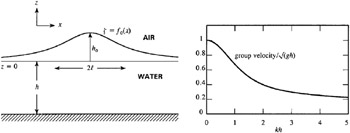
Let the motion be started from rest at t = 0 by an initial surface elevation ? = f o( x). By the method of 5.5.1 the surface displacement for t > 0 is found to be

where  .