Hydrodynamics and Sound

Providing a detailed study of a wide range of highly simplified model problems,' this book presents the most important theoretical methods that will enable the reader to develop analytical models of practical significance.
 TABLE OF CONTENTS
The distinguishing feature of long waves on shallow water is that the fluid motions are predominantly parallel with the solid bottom. Fluid particles rise and fall during the passage of a wave through a distance comparable with the surface wave amplitude ? o (Figure 5.1.4), but at the same time they perform very much larger horizontal excursions over distances~ ? o ?/h ( ?  h). This observation can be made the basis of the derivation of a simplified equation of motion for long waves on shallow water, based on the hypothesis that the rate of change of the vertical component of fluid momentum (normal to the bottom) can be neglected.
Indeed, let us integrate the z component of the linearised momentum equation from a general depth z to the surface at z = ?,

where p is the pressure in the fluid at z and p o ? p o( x, y, t) is the applied surface pressure (if any). The maximum vertical acceleration of a fluid particle ~ ? 2 ?, so that the maximum value of the left-hand side ~ ? 2 ? h. This is small compared with the term in ? on the right-hand side, provided that

For shallow-water waves we anticipate that the wavelength  , so that this condition is equivalent to
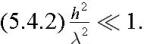
When this condition is satisfied Equation (5.4.1) shows that the perturbation pressure  is independent...