Hydrodynamics and Sound

Providing a detailed study of a wide range of highly simplified model problems,' this book presents the most important theoretical methods that will enable the reader to develop analytical models of practical significance.
 TABLE OF CONTENTS
Let us now consider the dissipation term  on the right-hand side of energy equation (5.2.2). The dissipation per unit surface area is just equal to
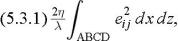
where the integration is over the two-dimensional region beneath one wave, as in Figure 5.2.2. The motion has thus far been assumed to be entirely irrotational, and in this case the rate of strain e ij decreases rapidly with distance from the free surface, so that the main contribution to the dissipation integral is the interior damping that occurs within a layer of fluid of width ~ ? near the surface. However, viscous effects cannot strictly be neglected, and for a wave of frequency ? the motion is actually rotational within a boundary layer of width  on the bottom boundary at z = ? h ( 4.4, Example 1), which is typically very small compared with both the wavelength ? and the depth h. The velocity gradient and e ij can become very large within the boundary layer provided that ? ? h (when the wave experiences significant bottom drag), and it is then necessary to consider separately the contribution of the boundary layer, to overall damping.
There is a similar narrow boundary layer at the free surface, where irrotational and rotational components of the flow are coupled by the linearised stress-free boundary conditions

However, there is no rapid variation in velocity across this layer, and the contribution...