Hydrodynamics and Sound

Providing a detailed study of a wide range of highly simplified model problems,' this book presents the most important theoretical methods that will enable the reader to develop analytical models of practical significance.
 TABLE OF CONTENTS
The energy equation for surface waves over an incompressible fluid like water subject to viscous dissipation is conveniently derived from Equation (1.5.12) in which ? = ? gz and ? = ? o. When quantities of third order and higher are discarded, we have

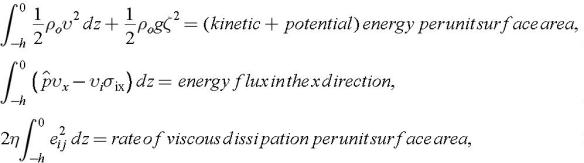
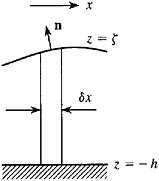
Let the waves propagate in the x direction and integrate the equation over the interior of a thin, vertical slice of fluid, aligned with the wave crests, of thickness ? x and of unit lateral span (Figure 5.2.1). For viscous flow the velocity v = ( ? x, 0, ? z) must vanish at the bottom z = ? h, and the stress-free condition at the free surface must be applied in the form ( p ? ij ? ? ij) n j ? pn i ? ? ij n j = 0 at z = ?, where ? z ? ? ?/ ? t. Retaining only second-order terms and considering the limit as ?x ? 0, we find

where
and

is the pressure reduced by the mean hydrostatic pressure ? ? o gz.
The wave energy E per unit surface area for the wave (5.1.11) on water of finite depth consists of kinetic energy T and potential energy Q, whose values we first calculate for the fluid region ABCD of Figure 5.2.2 beneath