Hydrodynamics and Sound

Providing a detailed study of a wide range of highly simplified model problems,' this book presents the most important theoretical methods that will enable the reader to develop analytical models of practical significance.
 TABLE OF CONTENTS
Fluid motion that is the same in all planes parallel to the xy plane, say, with no velocity in the z direction, is said to be two dimensional, with all flow quantities dependent on only x, y, and possibly the time t. Fully three-dimensional flow problems can often be regarded as locally two dimensional in small, confined neighbourhoods, and the two-dimensional solutions can sometimes be pieced together to provide a useful representation of the three-dimensional flow. Furthermore, considerable insight into properties of more general flows can frequently be obtained by a study of the solutions of analogous two-dimensional flows. Many of these solutions can be obtained in analytic closed form by methods based on the theory of complex variables; these methods are studied in this chapter for an ideal, incompressible fluid.
Let the velocity v have components u, ? in the x and y directions, respectively. For incompressible motion, the equation of continuity
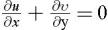
can be satisfied by introduction of the stream function ?( x, y), where

Consider two points, 1 at ( x 1 , y 1) and 2 at ( x 2 , y 2), lying on curve C of Figure 3.1.1. The volume flux from left to right through C (per unit span , i.e. per unit length normal to the plane of the paper) is ? C v n ds, where s is arc...