Hydrodynamics and Sound

Providing a detailed study of a wide range of highly simplified model problems,' this book presents the most important theoretical methods that will enable the reader to develop analytical models of practical significance.
 TABLE OF CONTENTS
Vibrating bodies, regions of turbulent flow, the mixing of flows of different temperatures, and other unsteady phenomena produce fluctuations in pressure that propagate through a real fluid as sound, that is, as a succession of compressions and rarefactions. In applications we are usually concerned with wave amplitudes that are small relative to the mean undisturbed pressure. Therefore, in a first approximation the equations of motion may be linearised and combined to form the wave equation for sound propagation. Sound waves are nondispersive in a homogeneous fluid over a broad range of frequencies for which viscous and thermal diffusion are small; in particular, this is true at audible frequencies, and it ensures that pressure fluctuations representing speech remain coherent over large distances.
The intensity of sound in air is usually measured on a decibel scale by the quantity
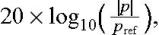
where the p is a measure of the characteristic acoustic pressure and p ref = 2 10 ?5 N/m 2 is a standardised reference pressure. Thus p = p o ? 1 atm (= 10 5 N/m 2) is equivalent to 194 dB. A very loud sound, ~120 dB, corresponds to

Nonlinear effects begin to be important for deafening sounds of intensities ~160 dB, for which p/p o ~ 0.02 and p ~ 0.3 lbs/in 2.
We shall see that sound waves are longitudinal disturbances , such that the passage of a wave in the form of a pressure fluctuation...