Hydrodynamics and Sound

Providing a detailed study of a wide range of highly simplified model problems,' this book presents the most important theoretical methods that will enable the reader to develop analytical models of practical significance.
 TABLE OF CONTENTS
Consider waves on water of arbitrary depth h generated by a time harmonic pressure distribution

applied at the free surface z = 0. In applications we are of course concerned with real pressures, and it is understood that the solution of the wave problem will ultimately be combined with its complex conjugate. However, the exponential frequency dependence is convenient because in the linearised approximation all fluctuating quantities are proportional  , and this factor may therefore be temporarily suppressed.
The velocity potential is accordingly defined by the Fourier integral [compare (5.1.11)]

where  ( k, ? o) is determined in terms of p o( k) by the surface condition of (5.1.5):

Hence the surface displacement ? = ( ?1/ i ? o)( ? ?/ ?z) z = 0 is given by
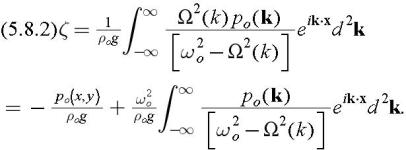
When ? o is real the value of integral (5.8.2) is ambiguous because of the poles at  on the real axis. Real poles were avoided in the initial-value problems of 5.5 effectively by the addition of a small positive imaginary part to the frequency, thereby ensuring a null solution for t < 0. We now require a solution satisfying the radiation condition of steady outgoing wave behaviour, in that wave energy must radiate away from the sources. This solution can also be obtained, however, by the same formal device of replacing ? o with ? o +