Initial-Boundary Value Problems and the Navier-Stokes Equations
One aim of this section is to indicate the limitations of the energy method in a discussion of well-posedness. We shall employ the Laplace transform in time to solve parabolic initial-boundary value problems and shall show that these problems are strongly well-posed in the generalized sense if and only if a certain determinant condition is fulfilled. Using this technique, one can decide the question of well-posedness in the generalized sense. In contrast to this, if the boundary conditions are neither of Dirichlet nor of Neumann type, the energy method applies only in exceptional cases.
Consider an equation
in the domain 0 ? x< ?, t ?0, under n linearly independent boundary conditions at x=0,
and an initial condition
Assumptions. The n n matrices A, L 0, L 1 are assumed to be constant; results for variable coefficients are stated at the end of this section, without proof however. Throughout, the assumption of strong parabolicity
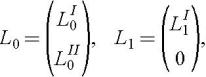
is essential. Concerning the boundary conditions: If rank L 1= r, then we can assume, without restriction, that the matrices are of the form
where
,
have size r n, and the boundary conditions take the form
(The cases of a Dirichlet condition, r=0, and a Neumann condition, r= n, are formally included in our discussion. However, the reader...