We will use the following result proved in analysis. It is (a special case of) the Arzela-Ascoli Theorem.
Theorem A.4.1. Let ? C R s be a closed bounded set, and let u m : ??C n denote a sequence of functions with the following properties:
-
For each ?>0, there is a ?>0 independent of m with
-
There is a K independent of m with
Then there is a continuous function u: ?? C n, and a sequence of indices m j ?? with
To apply the result, assume that we have a sequence of functions
which is uniformly smooth; i.e., u m ? C ? for all m, and for all nonnegative integers p, q there is a constant C(p, q) independent of m with
We want to show:
Theorem A.4.2. There is a function u ? C ?, and a sequence m j ?? with
In short, a subsequence of u m converges along with all its derivatives to a C ? -limit.
Proof. By the Arzela-Ascoli Theorem there is a continuous u and a sequence m=m j ?? with
Now apply the Arzela-Ascoli result to the sequence
and obtain the existence of a continuous ? and a sequence j k ?? with
From
we conclude that for m= m jk ??,
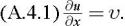
Hence u is differentiable w.r.t. x, and
Let us show...
Copyright The Society for Industrial and Applied Mathematics 2004 under license agreement with Books24x7

 TABLE OF CONTENTS