7.5. Mildly Ill-Posed Half-Space Problems
Consider a parabolic problem
in 0 ? x< ?, t ?0, with initial condition
and boundary conditions at x=0,
All matrices are constant (in general, complex), A, B, C have size n n,  ,
,  have size r n, and
  has size (n ?r) n. We make the reasonable assumption that
  and have full rank in order to have n linearly independent boundary conditions. Furthermore, we assume for simplicity that the eigenvalues
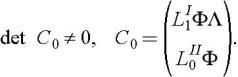
of A are distinct. First we want to use the ideas of the previous section to derive a formal solution formula. Second, we will show that the problem is not strongly well-posed in the generalized sense (see Definition 3 of Section 7.3) unless
Here
Hence there are two different ways in which a problem (7.5.1) (7.5.3) can become ill-posed: First, there can be a sequence of eigenvalues s ? with Re s ? ??; see Lemma 7.4.3. Second, no such sequence exists, but det C 0=0. In the second case the ill-posedness is of a milder nature: One can still estimate the solution if one uses derivatives of the data. In contrast to the weakly ill-posed Cauchy problems of Chapter 2, a perturbation by lower-order terms still does not lead to arbitrarily fast exponential growth.
7.5.1. Formal Solution
Laplace transformation of (7.5.1) (7.5.3) gives us
For each fixed s with sufficiently large real part, we want to solve...


 TABLE OF CONTENTS